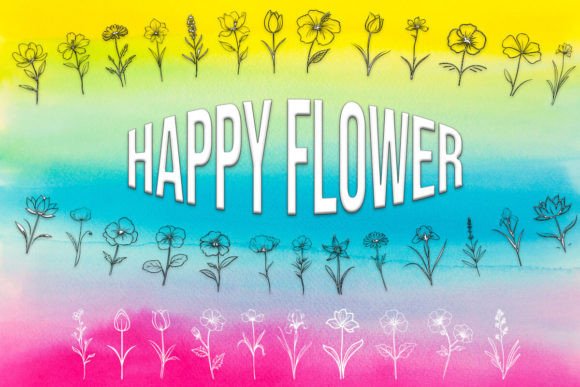
Happy Flower Font: A Playful Touch for Vibrant Editorial Designs
Happy Flower and the Art of Expressive Dingbats Fonts
As a designer who regularly works on digital magazines and branded newsletters, I’ve found that the right display font can transform a layout from standard to standout. Happy Flower, part of the Dingbats Fonts collection, is one such typeface that caught my eye—not just for its whimsical charm, but for how it injects warmth and personality into editorial spaces. It’s a font that feels like a handwritten note from a friend, yet carries the polish needed for professional publishing.
Happy Flower Font is a blend of vibrant letters and playful numbers, designed to elevate visual storytelling. While it’s not a body font, its character shines when used in titles, headers, and decorative accents. As a Dingbats font, it leans into the tradition of decorative, symbolic typography while offering a modern, clean aesthetic that works across digital and print formats. Whether you’re crafting a lifestyle blog header or a printable planner, Happy Flower adds a layer of editorial charm that’s hard to replicate with standard typefaces.
Happy Flower for Wedding Guides and Elegant Branding
Recently, I worked on a client’s wedding planning guide, where the goal was to evoke a sense of joy and celebration. Happy Flower became the perfect choice for section openers and quote highlights. Its rounded, floral motifs gave the layout a soft, romantic tone that aligned with the brand’s mood without overpowering the content.
What stood out was how well the font supported the publication’s identity. The Dingbats style elements—like floral swashes and curvilinear forms—added a touch of elegance while maintaining readability at larger sizes. For editorial designers looking to create a signature aesthetic in wedding guides, lifestyle magazines, or boutique brand kits, Happy Flower offers a unique visual voice that feels both personal and professional.
Using Happy Flower in Digital Magazines and Course PDFs
In a recent digital magazine layout for a wellness publication, I tested Happy Flower as a title font for feature articles. Paired with a clean sans serif like Open Sans for body text, it created a balanced visual hierarchy. The font’s cheerful rhythm made headlines feel inviting, encouraging readers to dive into longer-form content.
For course creators and digital product sellers, Happy Flower also works beautifully in chapter openers and worksheet headers. I used it in a coaching workbook PDF, where it helped break up dense sections with a visual lift. Its playful energy made the content feel more approachable—especially important in self-help and personal development materials.
Readability Considerations for Happy Flower
While Happy Flower is expressive and visually engaging, it’s best reserved for titles, pull quotes, and decorative accents rather than body copy. At smaller sizes, the font’s intricate Dingbats details can become muddied, especially on mobile screens or in low-resolution PDF exports. For print layouts, it performs well when given enough space to breathe, particularly in greeting cards, editorial illustrations, and packaging design.
When using Happy Flower in newsletters or blog headers, I recommend testing it across devices to ensure legibility. The font’s character-heavy design is a strength for visual impact but requires thoughtful placement to maintain editorial clarity. It’s also important to note that Happy Flower is best suited for short bursts of text—think headlines, social media graphics, or branded graphics—not for long-form reading.
Font Pairing and Practical Design Tips
One of the joys of working with display fonts like Happy Flower is experimenting with font pairings. In editorial design, I often pair it with a classic serif like Merriweather for body copy, creating a contrast between the ornamental and the readable. For modern digital layouts, a minimalist sans serif like Lato or Roboto works well to ground the design and keep navigation and captions clean.
Before finalizing any project, I always check the font’s included styles, ligatures, and alternates. Happy Flower offers a variety of glyph options that can be accessed through OpenType features in design software like Adobe Illustrator or Figma. Multilingual support and file formats (TTF, OTF, WOFF) are also important considerations, especially for international creators or those embedding fonts in web-based newsletters.
Commercial font licensing is another key factor, particularly for digital product creators. Whether you’re designing a printable planner, a course PDF, or a branded template, it’s essential to confirm that Happy Flower allows for commercial use. Most Dingbats Fonts collections include clear licensing terms, but it’s always wise to double-check before distribution.